

Welcome to Better Europe’s weekly update on EU Affairs.
FIRST EU OWN GOAL AHEAD OF U.S. WORLD CUP
After more than half a year of back and forths, MEPs finally caved in and approved the Agreement on Reciprocal, Fair, and Balanced Trade with the U.S., better known under the name of Trump’s Turnberry golf resort in Scotland where it was announced last summer. Replacing the failed TTIP deal, the Turnberry agreement is no less controversial as it included explicit commitments from the EU to water down its sustainability reporting rules and help American companies exporting to Europe through ‘flexibilities’ on the EU’s deforestation and carbon border tax legislation. Between last week’s trade committee vote last week and this week’s plenary vote, MEPs were promised that the rules would be suspended if Trump throws another tantrum and vows to impose ‘tariffs’ on one of the single market’s member states (remember Spain?) or plans to invade an EU member state or territory (remember Greenland?). And Parliament gets another go as the final-final decision will not be taken until April or May. This all sounds sensible, but with Trump you never know, and bad cop Andrew Puzder, his ambassador to the EU, already said that part of the deal is for the EU to purchase over a trillion in American oil, LNG and weapons. In the soccer-loving part of the world, we call that an own goal (h/t Albero Alemanno) — or, as the leader of the EP’s trade committee Bernd Lange put it: “now the ball is back in the field of the United States”.
DIGITAL EURO GOES ONLINE BUT NOT ONLINE YET
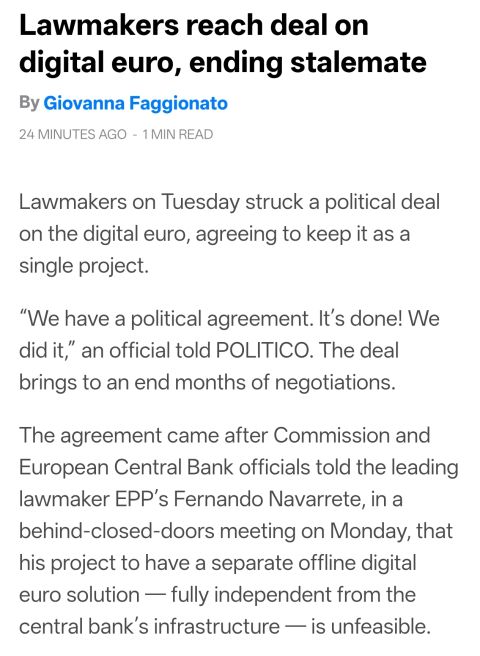
Habemus digital euro – at least that is what the Brussel gossip press seems to think. Apparently European Commission experts “explained it one more time” to Parliament rapporteur Fernando Navarrete, who then finally understood that his proposal to only have an offline digital euro would not be technically feasible. Holding on to an offline-only digital euro was his plan to ensure banks would be given more time to develop private solutions for better integrated online payments between consumers and in shops, transactions that today almost exclusively rely on U.S.-controlled brands and networks. Under pressure everything becomes liquid, and ahead of a potential public framework, European banks suddenly manage to build up cross-border functionality under brands such as Bizum and Wero allowing cross-border payments, something that was apparently impossible for two decades. Despite all the enthusiasm, the digital euro will not go online for a while as negotiations inside the Parliament will continue for a few more months, followed by trilogues with the Council. So, it will take a while before the cash lands in your digital wallet – sorry, in your favourite banking app of course.
LEFT BLOCK WINS IN DENMARK, BUT AT WHAT PRICE?
What a surprise: it’s back to old-school kingmaker politics in Denmark, with former Prime Minister Lars Løkke Rasmussen’s liberal Moderaterne party sitting comfortably in the middle between the ‘left’ and slightly smaller ‘right’ block, both of which do not control a majority in the Folketing parliament on their own. The party split off from Venstre in 2021 and for the second time will be kingmaker in government negotiations. While outgoing Prine Minister Mette Frederiksen’s social-democrats had their worst results in 120 years, they remain the country’s biggest party and she’s hoping to cling on to the leadership post with her predecessor’s support. Even if Frederiksen’s party arguably is caving in to populist demands (or nativist, as political analysist Cas Mudde puts it), remaining in power would be of great help for Europe’s wider socialist family. The party’s influence in EU politics nowadays mostly relies on Spain, with Prime Minister Pedro Sánchez and his comrade Teresa Ribera in Brussels.